S
Systems
Engineering & platform owners
Can context move between tools that were never connected?
Fails when ignored: Another silo that associates reconcile by hand.
Capital One Commercial Bank · Enabling Tools · 2022
A request to connect two systems became the opening to redesign the work around documents. I used the integration as leverage to study hundreds of existing users first.
01 · The strategic uncertainty
A document management tool had been built to centralize storage. Over time, teams submitted feature requests that prioritized functionality over a coherent experience.
When business leaders asked for a better Salesforce integration so associates could upload directly, I saw an opening. The request came with access to hundreds of people already using the tool, and nobody had asked them anything.
These were the business goals, not measured outcomes. I have kept the distinction because the implemented redesign was measured on NPS, and the savings targets were never independently verified to me.
02 · The system I was designing inside
I was the first embedded designer this team had worked with. My approach was to introduce human centered design and research, offer a perspective the team did not have, and keep asking why. These four lenses are how I kept that question answerable rather than annoying.
Engineering & platform owners
Can context move between tools that were never connected?
Fails when ignored: Another silo that associates reconcile by hand.
Commercial banking associates
Does it fit the way associates already handle documents?
Fails when ignored: A feature that exists but nobody has time to discover.
Product & Enabling Technologies leadership
Does it reduce handling time and consolidate the record?
Fails when ignored: A cleaner screen with the same cost underneath it.
The commercial banking client
Does the client get an answer faster because of it?
Fails when ignored: Internal tidiness the client never feels.
03 · The pivotal move
A team new to formal user research. A short term deliverable. One chance to widen it.
I built both a short term and a longer term research strategy: answer the integration question well enough to keep the commitment, and use the same access to understand how documents actually move through the associate workflow.
The feature request assumed one document at a time. The real grouping behavior determined the shape of the workflow.
Separating shared context from file-specific details would reveal where repeated metadata entry could be removed.
Observing breakdowns could distinguish a missing capability from an existing feature that people could not find.
Following information across systems would show whether the fix belonged in one interface or in the handoffs between them.
“The integration was the ask. The hundreds of people already using the tool were the opportunity.”
04 · From evidence to insight
Associates were entering the same metadata repeatedly for related documents. A feature that would have solved it already existed, and almost nobody used it. Underneath both problems sat a set of tools that could not pass context to each other.
“I have to put in the client identifier numbers and client name again, even if you selected you have ten documents to be uploaded for the same client.”
Commercial banking associateAssociates upload documents that share a client or a type, then re-enter identical metadata for every single file.
Enter shared information once, then ask only for what differs.
“I just don't use this tool often enough. I don't have time to play around with the system.”
Associate, on the existing common metadata featureCommon metadata was built alongside the core experience rather than inside it, so nobody had time to discover it.
Put the shortcut on the main path. An unused capability is not a capability.
Without an integration, associates copied identifiers between Salesforce and the document tool, then added proof of the upload by hand.
Workflow observation across toolsDisconnected systems meant the record of what happened had to be rebuilt in a second place, every time.
Pass the Record ID through, then return a shareable link that closes the loop.
05 · The redesign
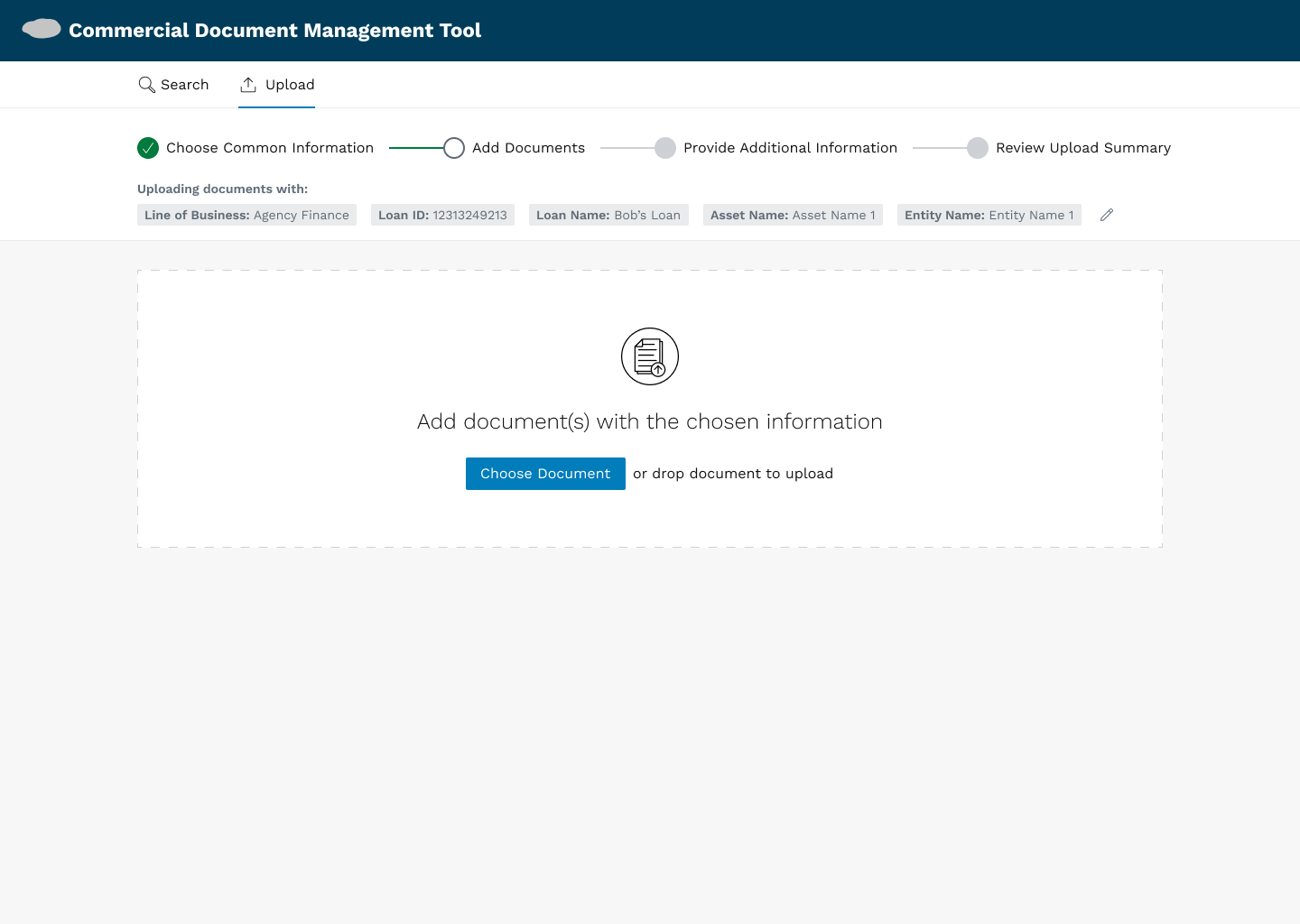
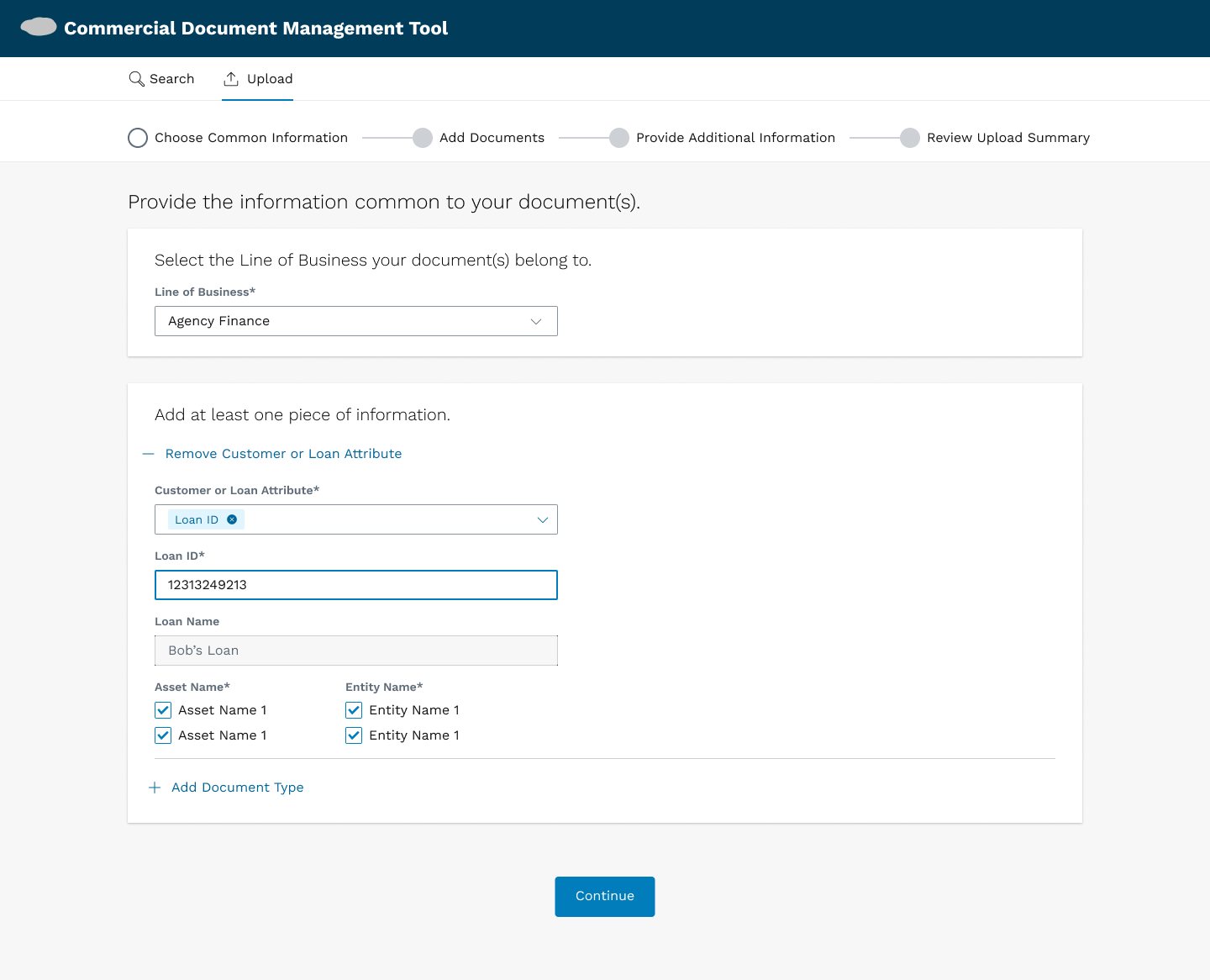
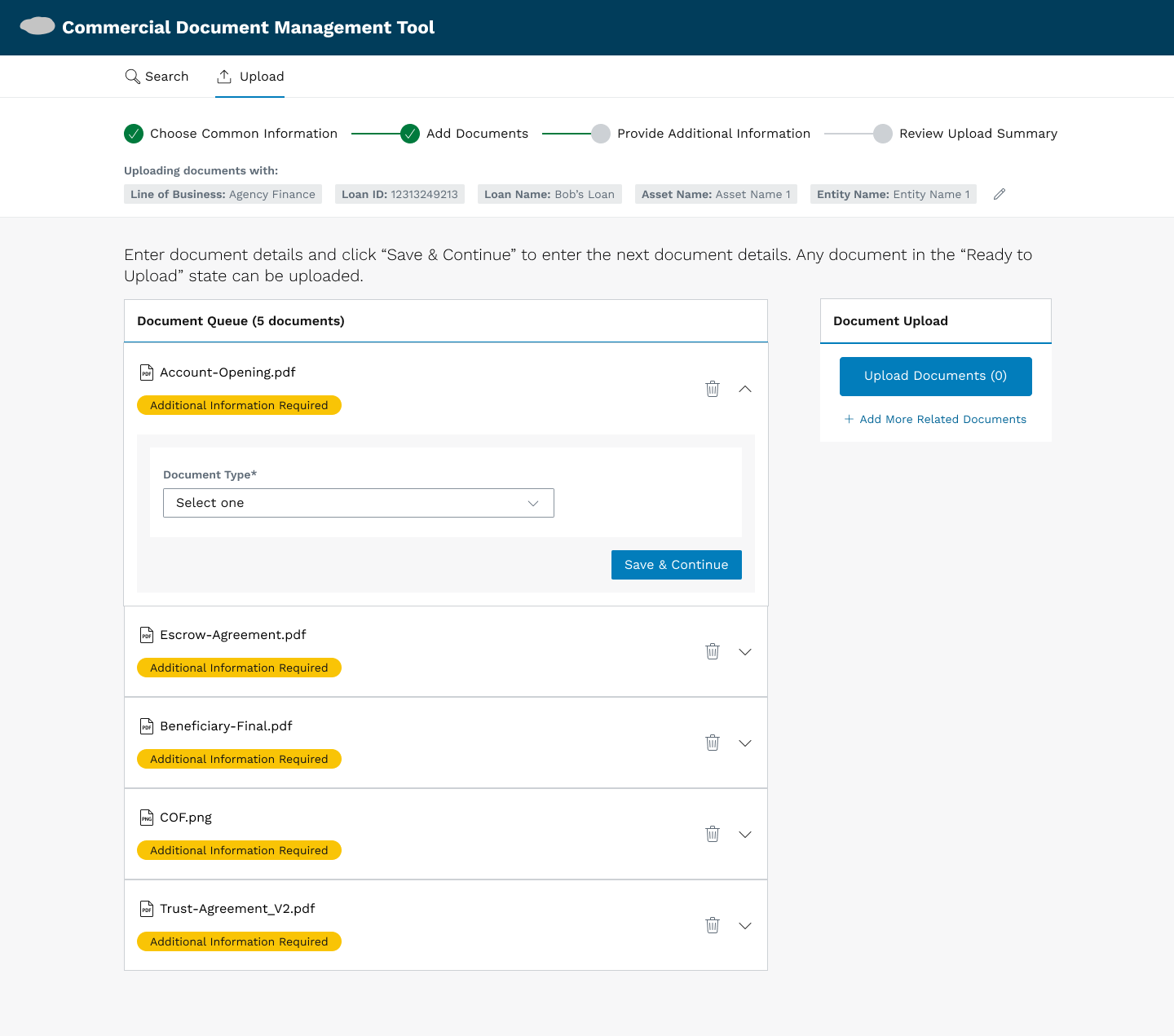
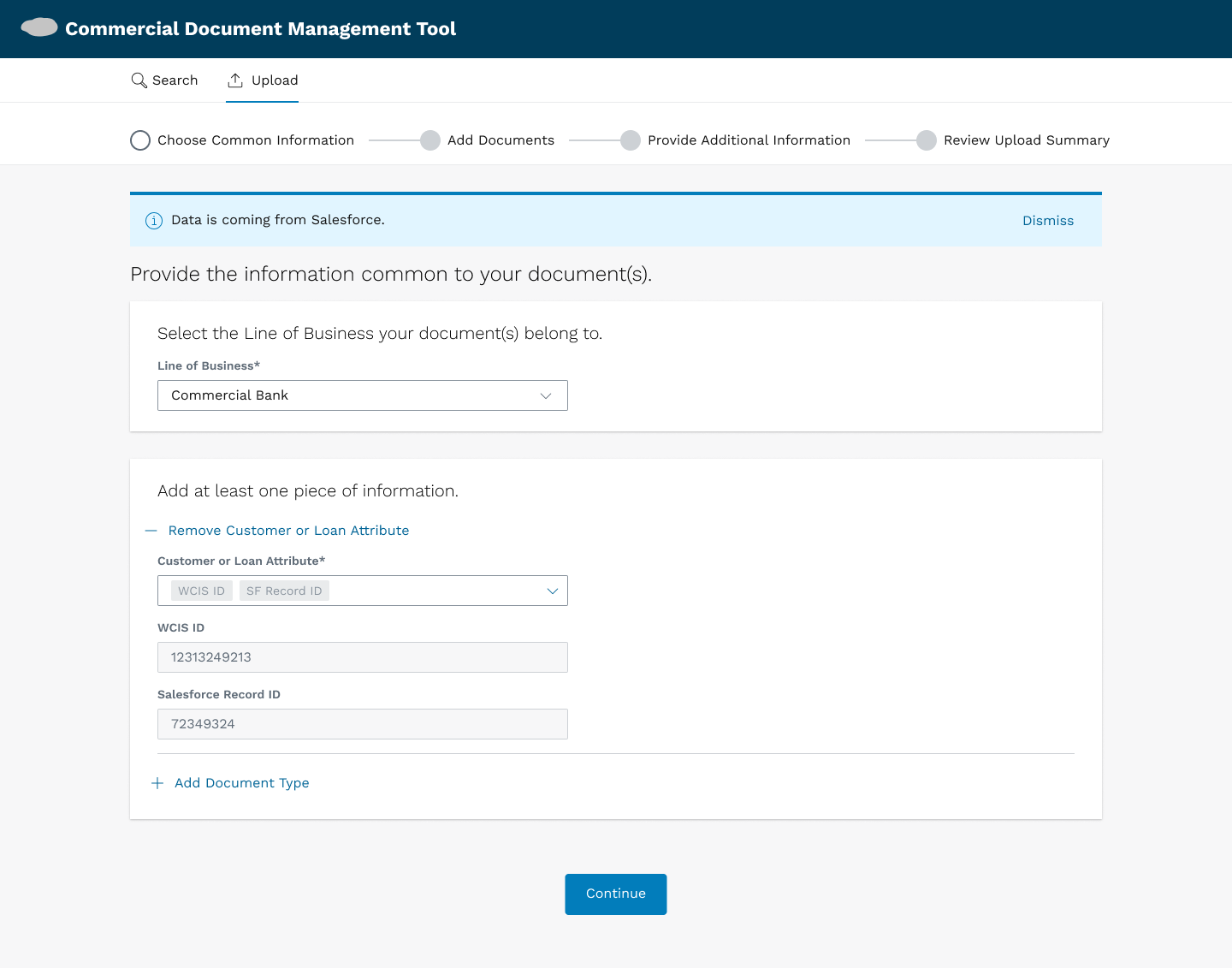
Most associates upload documents tied to a company identifier, know what information is required, and then select document types. I designed the flow around that pattern while leaving room for the cases that do not fit it.
06 · Connecting Salesforce
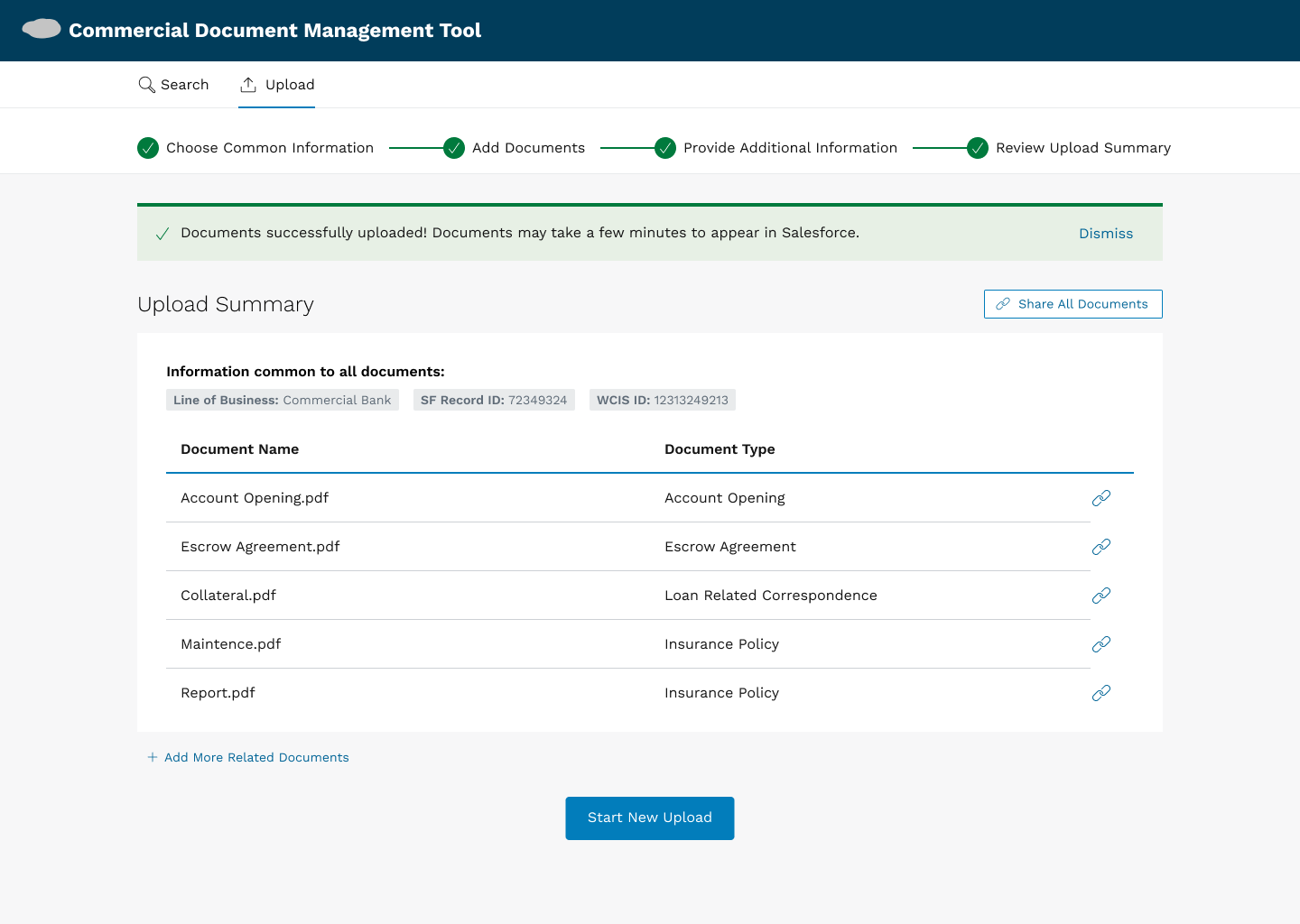
Research showed the existing workflow forced associates to add proof of their upload back into Salesforce by hand, purely because the systems did not talk. I proposed passing the Record ID and company information directly into the document tool, then returning a link that made the follow up unnecessary.
07 · The longer view
I mapped how documents and their data moved across the tools used in the commercial real estate loan process. Disconnected systems led to redundant data entry, lost documents, and manual work that extended the time required to close deals. Teal marks where the friction concentrated.
Collects documents from the client
Tags each file with client and document type
Uploads into the central document management tool
Records proof of the upload elsewhere
Email and shared drives
Salesforce
Central document management tool
Final repository tool
Documents arrive without enough context to connect them to the wider workflow.
The same client metadata is entered repeatedly for related files.
Identifiers are moved between Salesforce and the upload flow by hand.
Data stays trapped in the document and proof of work is recreated manually.
Attach client and deal context at the start.
Enter shared information once and retain it across the group.
Pass the Record ID and company context through the handoff.
Return a shareable link and pull the repository closer to the start of the process.
Associates received related documents through channels that did not preserve structured context.
Synthesized workflow observationShowed that the service problem began before the upload interface.
Related documents shared identifiers, but the workflow asked for those identifiers one file at a time.
Associate interviews and workflow observationProduced the shared-information-first structure used in the redesign.
Disconnected systems forced associates to recreate context the organization already held.
Synthesized workflow observationTurned the Salesforce integration into a way to remove re-keying rather than simply add an entry point.
Associates manually rebuilt the record of a completed upload in another system.
Synthesized workflow observationMade the wider case for connecting document data across the service.
Scroll horizontally to follow the full journey on smaller screens.
I presented this to the whole Commercial Bank Enabling Technologies organization, arguing for a common space where associates could share the documents and data they need, and for pulling the final repository tool toward the start of the process rather than the end.
08 · Bringing it to life
I led the handoff process to build a design and engineering collaboration culture in a team that had only handled small design requests before, and worked with the product manager to break the redesign into manageable steps with phased technical requirements.
Shared information first, related files together, and only the differences asked per document.
ImplementedRecord ID passed through, documents linked back, and a shareable link returned.
ImplementedA collaboration process for a team that had previously only handled small design requests.
IntroducedService blueprints showing how document data could move across the disconnected tools around us.
Presented to the org09 · Impact
IMPLEMENTED AFTER MY ROTATIONThe design was implemented after I had moved to the second team of my rotational program. The tool's NPS improved by 31 points. The time reduction and savings figures were business goals, not measured outcomes, and I have kept them labelled that way.
My education emphasized empathy with end users. My first end to end corporate project taught me that empathizing with team members is just as necessary to advocate for the user.
Stepping back to see how the tool fits the entire associate workflow is what made the longer term vision arguable while I was still shipping short term changes.
Aligning research and design objectives with broader business goals is where I found the work most interesting, more than implementing quick fixes.
The integration request was the leverage. Using it to study the hundreds of people already in the tool is what turned a feature into a direction.
I used a feature request to earn the right to study the workflow underneath it, shipped a redesign that people measurably preferred, and left the organization with a map of the problem that was too big for one tool.